AI mock interview
A full practice round you do out loud — questions built for the job you're actually applying to, follow-ups when you dodge something, and a report at the end that tells you how you sounded.
Get it on Google PlayHow a mock runs
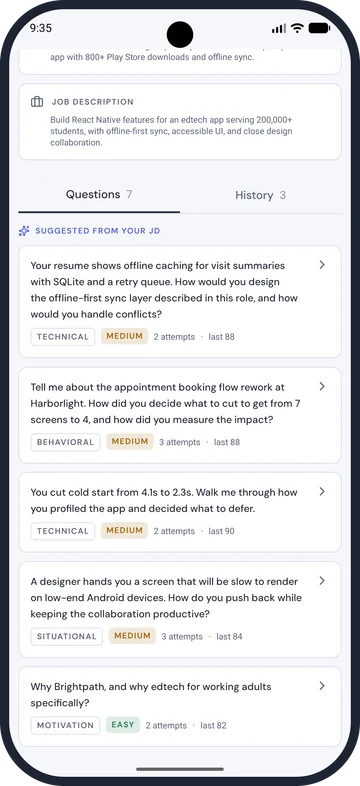
Paste the job description
Verbaly reads it the way a hiring manager would and builds a question set for that specific role — behavioral, technical, situational, whatever the job actually calls for.
Answer out loud
Five questions by default, up to eight if you want a longer round, roughly 60 to 90 seconds each. You talk; it listens. No typing your answers, because typing is not the skill being tested in a real interview.
Handle the follow-ups
Skip over the hard part of a question and the next one tends to land on exactly that. It's the closest thing to the moment an interviewer says "can you say more about that?"
Read the report
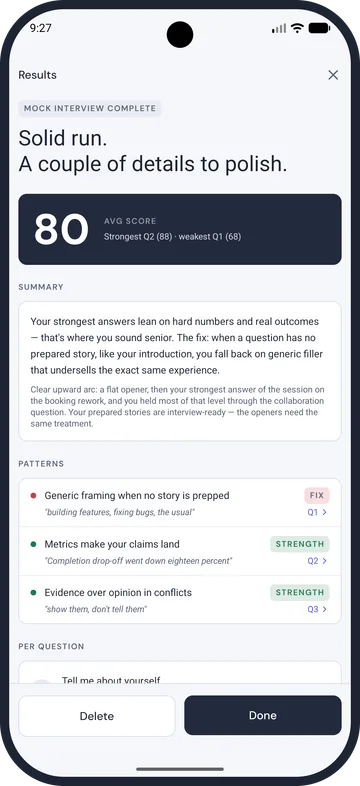
An average score across the round, your strongest and weakest questions, and the patterns that showed up more than once.
What it looks like
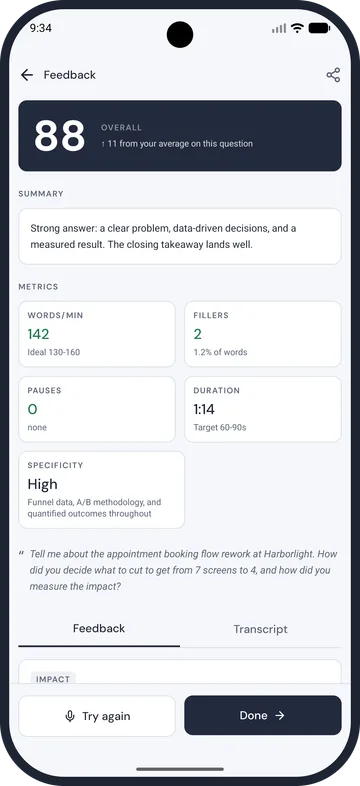
What the report actually tells you
Pacing
Your words per minute against a target of 130–160. Nearly everyone speeds up under pressure and nobody notices themselves doing it.
Filler words
How many times "um", "like" and "you know" appeared. You cannot hear your own fillers while you're talking — that's the whole problem with them.
Pauses
Where you stalled before answering, and how long for. A thinking pause is fine; a four-second one before every answer is a habit worth knowing about.
Specificity
Whether you gave a real example or talked around the question. Vague answers feel fine to give and read as evasive from the other side of the table.
A stronger version
What a better answer to that question would have covered — so you know what you left on the table, not just that something was missing.
Patterns across the round
The end-of-mock report groups what kept happening across the whole round, so you fix a habit rather than one bad response.
Why out loud matters
You can rehearse an answer perfectly in your head and still fall apart saying it. Reading over your notes builds recognition; it doesn't build the thing you need in the room, which is being able to say a coherent answer at a normal speed while slightly nervous.
That gap is where most interview prep quietly fails. The resume gets you into the room, and then thirty minutes of talking decides it — and the talking is usually the part nobody rehearsed.
Common questions
- What is an AI mock interview?
- It's a practice interview you do out loud with an AI interviewer instead of a person. You get asked a question, you answer by voice, and it responds — including follow-ups when your answer left something out. Afterwards you get a report on how you actually sounded.
- How long does a mock interview take?
- You choose the length before you start — five questions by default, up to eight. Answers are targeted at 60 to 90 seconds each, so a round takes about ten to fifteen minutes including the follow-ups.
- Does it ask follow-up questions?
- Yes. After you finish an answer, the next question can dig into whatever you were vague about. That's the part practising in the mirror can't do — the mirror never asks you to explain yourself twice.
- Do I need an account?
- No. There is no sign-up, no email, and no password. Your sessions and history stay on your phone.
Your first mock is free
A complete round with the full report at the end. No card, no account, nothing to cancel.
Get Verbaly on Google PlaySee exactly what's free · Practice single questions · What interviewing with AI is like